


The cornerstone of our Cognition OS
We are building a new category of AI.
The cornerstone of our Cognition OS
We are building a new category of AI.
We don’t just build on AI research — we contribute to it. Our work argues for a new architecture for how machines represent and reason with knowledge.

Scale doesn’t
solve meaning.
The industry is racing to make models bigger and faster. We think the harder and more important problem is how knowledge is represented, recalled and used in the first place.
Most AI today predicts the next most probable token in a sequence — extraordinary at it, and so fluent the output feels like understanding. But fluency isn’t understanding. Models work brilliantly at the token level and retrieval works over whole documents, yet neither aligns with the level at which knowledge actually lives: the concept.


A decade-long problem
that’s growing exponentially.
A single document holds many concepts; a single concept is scattered across many documents. That mismatch is architectural — not something more parameters or a bigger context window will patch.
It’s a research problem, and one that’s been developing in academic work for over a decade. That’s the problem we’ve taken on.
Not one paper.
A programme.
Three published papers, one argument: intelligence lives at the level of concepts — how they’re held across an ecology, how they compress and combine, and what happens when a model attends over them.

Cognition as an Ecology.
Internal, proximal, frontier.
Designing AI for Internal Memory, Proximal Ecosystems, and External Unknowns
Human knowledge lives in three domains: Internal — what you hold yourself; Proximal — the accessible resources around you; and Frontier — the external unknowns. Creativity arises from optimal synthesis between the three — the surprise gradient — and an AI that collapses them into one retrieval problem fails at all of them. This is the frame everything we build sits inside.
Atomic Units of X.
The compression layer of intelligence.
The formal core of the programme.
Intelligence works by organising evidence into reusable atoms that can be recombined. The Compression Calculus gives a formal way to compare surface evidence with atomic representations, and the Compounding Cascade shows how those gains can multiply across layers of abstraction.
We tested the first half on three Apache software projects — HBase, Hadoop and Maven — at paragraph level. HBase consolidates evidence into concepts at 22.9:1 (a 95.6% reduction) and Hadoop at 20.1:1 (95.0%), both past our 20:1 target. Maven, the smallest, reaches 11.4:1 and falls short. At message level, none of the three reach 20:1.
We report the limits as plainly as the wins: consolidation depends on corpus size and on how a unit is defined, and it measures consolidation, not yet retrieval quality or composition.
Special thanks to Benjamin Brey, Dr Sharon Jheeta and Priyanka Kochhar.
Compression, in tokens.
Where it saves, and where it doesn’t.
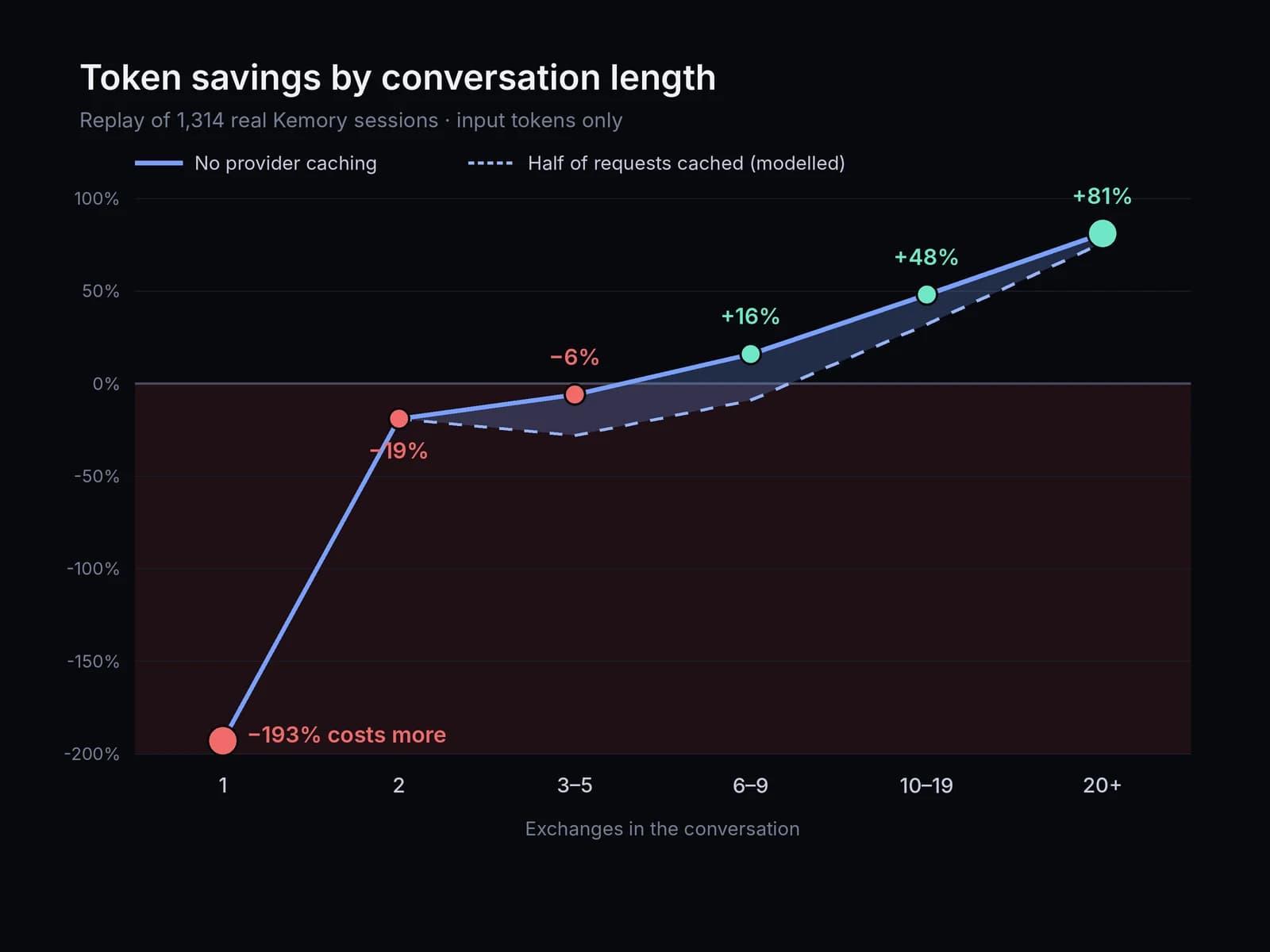
If intelligence is compression, memory should make AI cheaper to run, not heavier. We tested that by replaying 1,314 real conversations with and without Kemory.
The result: Kemory avoids 72% of the input tokens a model would otherwise re-read — 61% after Kemory’s own overhead.
The catch: it depends on conversation length. Kemory costs more on one-off prompts, breaks even at about five exchanges, and saves 81% past twenty. The 7% of sessions that run that long produce 90% of the tokens saved.
An upper bound on input tokens only, from a replay rather than billing data. Full paper in preparation.
Concept-Grounded Attention.
What worked, and what didn’t.
A Controlled Evaluation of Graph-Injected Attention, Temporal Versioning, and Epistemic Status
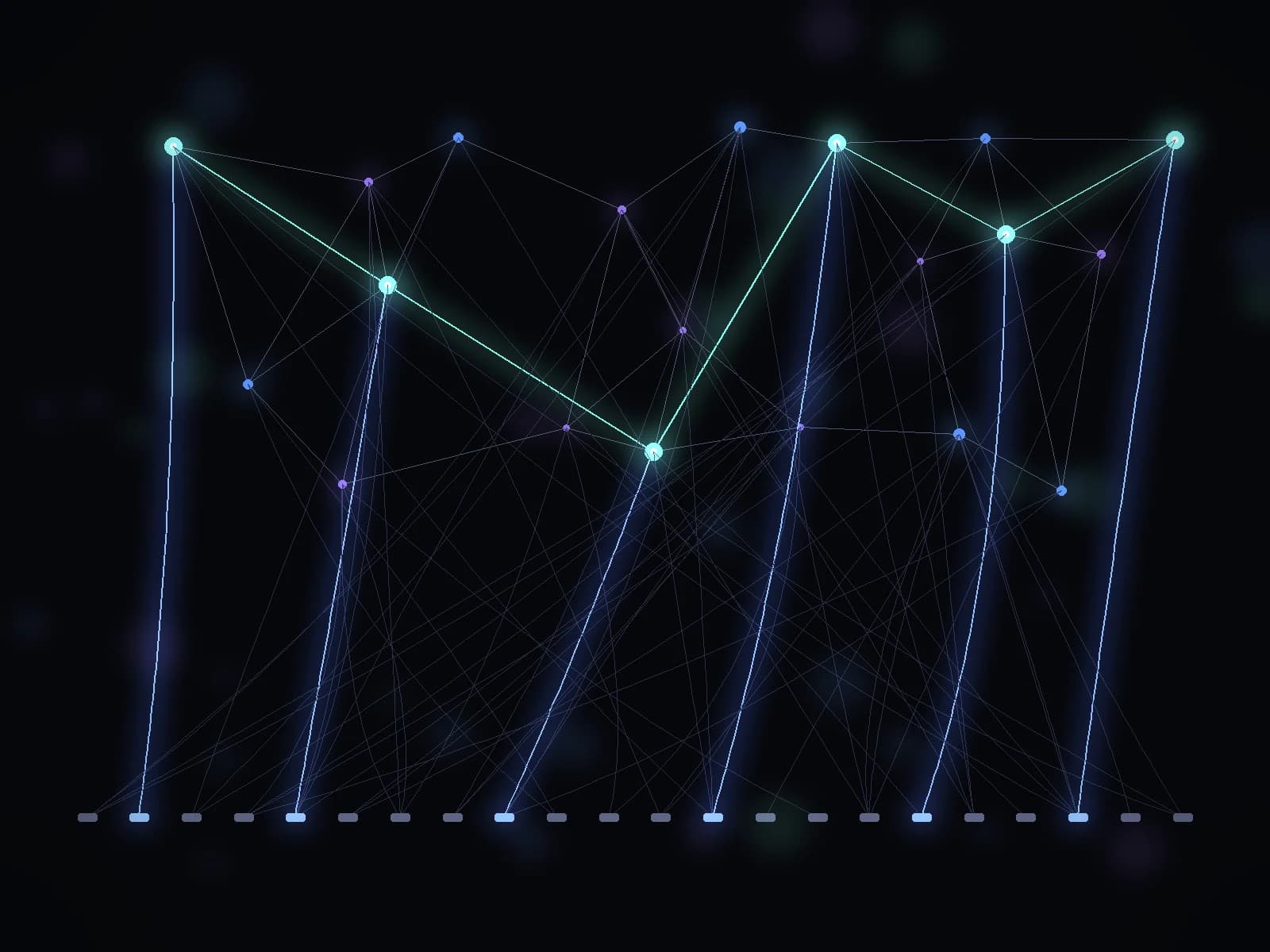
We put the concept graph inside the transformer, then tested every mechanism against itself switched off. The headline idea — steering attention with graph structure — did not change a single answer. The model already attended to the right concepts 2.76× more than distractors, and did exactly the same with the mechanism disabled.
What did work is the memory model underneath. Making time explicit lifted LongMemEval accuracy by 13 to 25 points for every generator tested, up to 122 billion parameters. Giving each claim an epistemic status cut unsupported assertions from 28% to 0.1% in a small fine-tuned model, and from 19–68% to 0–5% in 72–122B models. Temporal validity and epistemic status belong in the data model first; attention tricks have to beat their own off-switch.
Research in the open,
for the field.
We share our thinking with the research community because a new architecture for intelligence is bigger than any one company. We publish our frameworks, our findings, and the problems we haven’t solved yet.


We’re not
working alone.
The idea that intelligence depends on reusable, composable units isn’t ours alone — it runs through decades of research. Cognitive science shows that experts think in compressed chunks, not raw detail. Information theory ties compression to prediction and understanding.
Neurosymbolic AI works to combine the fluency of neural models with the structure and traceability of symbolic reasoning. And recent work on compositional generalisation and library learning shows systems discovering and reusing their own abstractions.
Our contribution is to bring these threads together into one measurable framework — and to build on it. We’re advancing a frontier alongside a scientific community increasingly converging on the same insight.
We’ll tell you exactly where we are.
And where we’re going.
In 2020, Henry Kautz set out a taxonomy for how neural and symbolic systems can be combined — a ladder running from systems that merely bolt the two together, through those where each calls the other, to systems where symbolic reasoning is genuinely embedded in the neural substrate.
Most of what ships today sits near the bottom of that ladder: a language model with a retrieval step attached. SeKondBrain sits at Type 2.5 — the concept graph is not a lookup the model calls, it is structure the reasoning runs through. Meaning is held symbolically and stably; reasoning is traceable; the neural layer reads the world and the symbolic layer holds what it means.
We are not at the top of the ladder, and we will not claim to be. The step above is where symbolic structure and neural computation stop being two systems in conversation and become one. That is the problem we are working on.

The problems we
haven’t solved yet.
One active workstream, and no victory lap.